
Applying to a university is an exciting milestone in a student’s academic journey. It represents the transition from secondary education to higher learning and opens the door to new opportunities, experiences, and career paths. However, the university application process can also be complex and competitive. Every year, thousands of qualified students miss opportunities at their preferred institutions because of avoidable mistakes during the application process.
Many students focus only on grades and test scores while overlooking other important aspects of their applications. Others underestimate deadlines, submit incomplete documents, or fail to properly research universities before applying. Even small errors can negatively impact admission decisions and scholarship opportunities.
The good news is that most application mistakes can be avoided with proper planning, organization, and attention to detail. Understanding the most common errors allows students to prepare stronger applications and improve their chances of acceptance.
This comprehensive guide examines the most frequent mistakes students make when applying to universities and provides practical strategies for avoiding them.
Why University Applications Matter
University applications are more than just forms and documents. They provide admissions officers with a complete picture of a student’s academic achievements, personal qualities, leadership potential, and future aspirations.
Admissions committees evaluate applicants based on multiple factors, including:
- Academic performance
- Personal statements
- Recommendation letters
- Extracurricular involvement
- Leadership experiences
- Community engagement
- Career goals
Because competition is often intense, even minor mistakes can reduce an applicant’s chances of success.
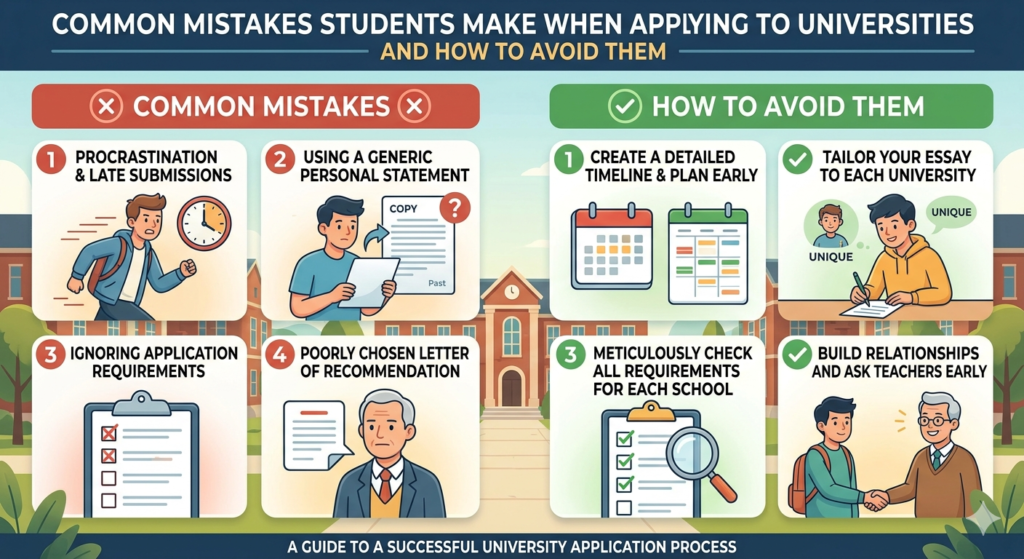
Mistake 1: Starting the Application Process Too Late
One of the most common and costly mistakes students make is delaying the application process.
Many students assume they have plenty of time until deadlines approach. As a result, they rush through important tasks such as writing essays, gathering documents, and requesting recommendation letters.
Why This Is a Problem
Late preparation often leads to:
- Poor-quality essays
- Missing documents
- Increased stress
- Missed scholarship opportunities
- Deadline-related errors
How to Avoid It
Students should begin planning at least 12 months before application deadlines.
A timeline may include:
12–18 Months Before
- Research universities
- Improve academic performance
- Prepare for standardized tests
6–12 Months Before
- Draft personal statements
- Request recommendation letters
- Explore scholarship opportunities
3–6 Months Before
- Complete applications
- Review all documents
- Submit materials early
Early preparation significantly improves application quality.
Mistake 2: Applying Without Researching Universities
Some students apply to universities simply because of rankings, reputation, or recommendations from friends and family.
However, every university has unique strengths, cultures, academic programs, and expectations.
Consequences
Students may:
- Apply to unsuitable programs
- Waste application fees
- Choose institutions that do not align with their goals
How to Avoid It
Research each university thoroughly.
Consider:
- Academic programs
- Campus culture
- Location
- Tuition costs
- Student support services
- Career outcomes
Selecting universities that match personal goals increases satisfaction and success.
Mistake 3: Ignoring Admission Requirements
Different universities have different admission criteria.
Some students assume all institutions require the same documents and qualifications.
Common Oversights
- Missing prerequisite courses
- Incorrect test scores
- Incomplete forms
- Missing language proficiency requirements
How to Avoid It
Carefully review official admissions websites and create a checklist for each institution.
Verify:
- Academic requirements
- Application deadlines
- Required documents
- Testing requirements
Never rely solely on unofficial sources for admissions information.
Mistake 4: Writing Generic Personal Statements
The personal statement is often one of the most important parts of an application.
Unfortunately, many students submit essays that are vague, generic, and similar to thousands of others.
Common Problems
Students often write:
- Overused clichés
- Broad statements
- Generic career goals
- Unclear motivations
Why It Matters
Admissions officers read thousands of essays.
Generic essays fail to stand out.
How to Avoid It
Write authentic and specific essays.
Discuss:
- Personal experiences
- Challenges overcome
- Academic interests
- Future aspirations
Use real examples that demonstrate growth and character.
A compelling personal story is often more memorable than a list of achievements.
Mistake 5: Focusing Only on Grades
Strong grades are important, but they are not the only factor universities consider.
Many students neglect extracurricular activities, leadership experiences, and community involvement.
Why This Is a Mistake
Universities seek well-rounded individuals who contribute to campus communities.
Applicants with excellent grades but limited involvement outside the classroom may appear less competitive.
How to Avoid It
Participate in meaningful activities such as:
- Student organizations
- Sports
- Volunteer work
- Academic competitions
- Community service projects
Quality involvement matters more than quantity.
Mistake 6: Choosing Quantity Over Quality
Some students believe that joining numerous clubs and activities will impress admissions officers.
In reality, admissions committees often value depth over breadth.
Common Issue
Students list dozens of activities but demonstrate little meaningful involvement.
Better Approach
Focus on a few activities where you:
- Show commitment
- Develop leadership skills
- Make measurable contributions
Long-term dedication often has a stronger impact than superficial participation.
Mistake 7: Requesting Recommendation Letters Too Late
Recommendation letters provide valuable insights into a student’s abilities and character.
However, many students wait until the last minute to request them.
Consequences
Teachers may:
- Have insufficient time
- Write generic letters
- Decline requests altogether
How to Avoid It
Request recommendations several months before deadlines.
Provide recommenders with:
- Academic achievements
- Career goals
- Resume
- Application details
Giving recommenders adequate time often results in stronger letters.
Mistake 8: Submitting Applications Without Proofreading
Simple grammar, spelling, and formatting errors can create negative impressions.
Common Problems
- Typographical errors
- Incorrect university names
- Missing information
- Poor formatting
Why It Matters
Attention to detail reflects professionalism and seriousness.
How to Avoid It
Before submission:
- Review documents multiple times
- Use grammar-checking tools
- Ask teachers or mentors for feedback
Fresh perspectives often identify errors students overlook.
Mistake 9: Missing Application Deadlines
Deadlines are among the most critical aspects of university admissions.
Late applications are often rejected automatically.
Causes
Students may:
- Miscalculate dates
- Forget requirements
- Experience technical issues
Prevention Strategies
Use:
- Calendars
- Planning apps
- Reminder systems
Aim to submit applications several days before official deadlines.
Early submissions reduce stress and allow time to resolve unexpected problems.
Mistake 10: Neglecting Scholarship Opportunities
Many students focus entirely on admission and forget about financial aid.
This mistake can significantly increase educational expenses.
Why Scholarships Matter
Scholarships may:
- Reduce tuition costs
- Cover living expenses
- Minimize student debt
How to Avoid It
Research scholarships early.
Explore:
- University scholarships
- Government programs
- Private foundations
- Community organizations
Many scholarships have separate deadlines and requirements.
Mistake 11: Applying Only to Highly Competitive Universities
Some students apply exclusively to elite institutions.
While ambition is valuable, this strategy can be risky.
Potential Problem
Highly competitive universities often reject many qualified applicants.
Better Strategy
Create a balanced list that includes:
Reach Schools
Highly competitive institutions.
Match Schools
Universities where admission is reasonably likely.
Safety Schools
Institutions where admission is highly probable.
This approach increases overall success rates.
Mistake 12: Ignoring Financial Planning
Many students focus on admissions without considering long-term costs.
Expenses to Consider
- Tuition
- Housing
- Food
- Transportation
- Health insurance
- Personal expenses
How to Avoid It
Create a realistic budget before applying.
Compare total costs rather than tuition alone.
Financial preparation prevents future difficulties.
Mistake 13: Underestimating English Language Requirements
International students often overlook language proficiency requirements.
Common Exams
- IELTS
- TOEFL
- Duolingo English Test
Risks
Low scores may:
- Delay admission
- Require additional coursework
- Result in rejection
Solution
Begin language preparation early and allow time for retesting if necessary.
Mistake 14: Failing to Demonstrate Interest
Universities appreciate students who genuinely understand and value their institutions.
Common Error
Submitting applications that appear copied and customized minimally.
Better Approach
Demonstrate knowledge of:
- Academic programs
- Research opportunities
- Campus culture
- University values
Specific details show genuine interest.
Mistake 15: Exaggerating Achievements
Some students believe embellishing accomplishments will improve admission chances.
Why This Is Dangerous
Admissions officers may verify information.
Dishonesty can result in:
- Rejection
- Revoked admissions offers
- Damaged credibility
Best Practice
Always present achievements accurately and honestly.
Authenticity builds trust and credibility.
Mistake 16: Ignoring Interview Preparation
Some universities require interviews as part of the admissions process.
Students often underestimate their importance.
Common Interview Questions
- Why do you want to attend this university?
- What are your career goals?
- What challenges have you overcome?
Preparation Tips
- Practice responses
- Research the institution
- Conduct mock interviews
Confidence and preparation improve performance significantly.
Mistake 17: Comparing Yourself Constantly to Others
The admissions process can become stressful when students constantly compare themselves with peers.
Negative Effects
Comparison may lead to:
- Anxiety
- Reduced confidence
- Poor decision-making
Better Approach
Focus on personal growth and strengths.
Every applicant has a unique journey and set of experiences.
Mistake 18: Failing to Seek Guidance
Many students try to navigate the application process entirely alone.
Helpful Resources
Students can seek advice from:
- Teachers
- School counselors
- University representatives
- Alumni
- Mentors
Experienced guidance can improve application quality and reduce mistakes.
The Importance of Organization
Organization is one of the most effective ways to avoid application mistakes.
Students should maintain records of:
- Deadlines
- Login information
- Required documents
- Scholarship applications
- Communication with universities
A well-organized approach reduces stress and improves efficiency.
Building a Strong Application Strategy
Successful applicants typically follow a structured plan.
Research Thoroughly
Understand each university’s expectations.
Prepare Early
Avoid rushing important tasks.
Stay Organized
Track deadlines and requirements.
Seek Feedback
Improve essays and application materials.
Remain Authentic
Present genuine experiences and aspirations.
These practices increase the likelihood of positive outcomes.